
Climate Change and Turbulence: Why Flights Are Getting Bumpier (and What Science Predicts for 2050)
Clear-air turbulence over the North Atlantic has increased 55% since 1979. Here's the atmospheric science behind the trend, what's projected through 2050, and what it means for passengers, airlines, and safety.
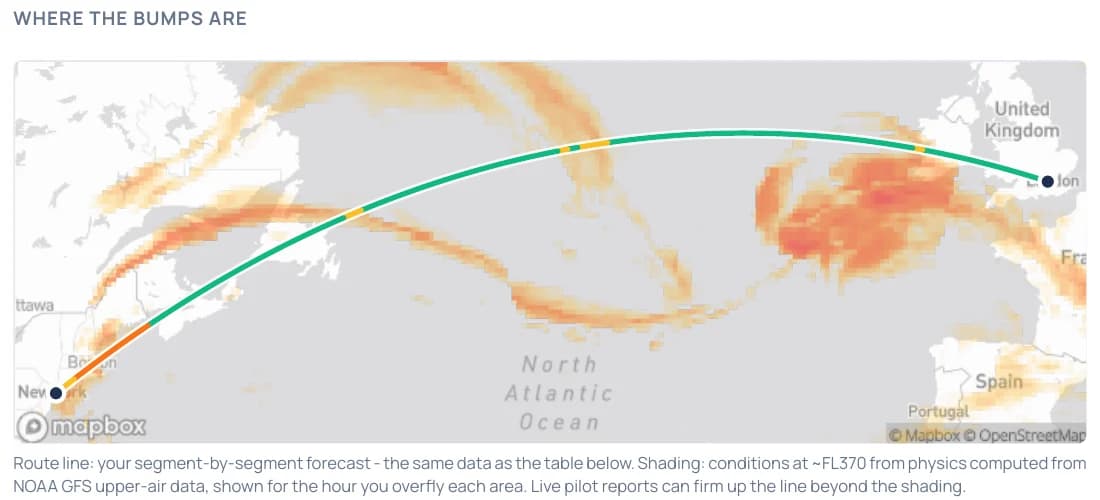
If you've flown internationally more than once in the last decade and noticed the bumps seem to be getting worse - you're not imagining it. Peer-reviewed atmospheric research confirms that severe Clear Air Turbulence over the North Atlantic has increased roughly 55% since 1979, and the trend is projected to continue through mid-century. The cause is climate change - not in the way most people expect, but through a specific and well-understood mechanism involving the jet stream.
This article walks through what the data shows, the atmospheric physics driving it, what's projected for 2050 and 2100, and what it means for you when you book your next long-haul flight.
The headline finding
The most-cited work in this field comes from Dr. Paul Williams and colleagues at the University of Reading. Their 2023 paper in Geophysical Research Letters analysed 40 years of ERA5 reanalysis data and found, over a single representative point in the North Atlantic flight corridor:
| Turbulence severity | Change, 1979 vs. 2020 |
|---|---|
| Light | +17% |
| Light-to-moderate | +37% |
| Moderate | +37% |
| Moderate-to-severe | +41% |
| Severe | +55% |
The biggest increase was in the most severe category. That's unusual - most climate trends are statistically visible first in the mean and only later in the extremes. Turbulence appears to be the opposite: the tails of the distribution are getting fatter faster than the middle is shifting.
The physics - why this happens
The jet stream is a ribbon of fast-moving air at roughly 30,000 to 40,000 feet - exactly where long-haul aircraft cruise. It forms along the boundary between cold polar air and warm subtropical air. The sharper that temperature contrast, the faster the jet stream blows.
Climate change is warming the Arctic about four times faster than the global average - a phenomenon called Arctic amplification. That would, naively, suggest the jet stream is weakening as the pole-to-equator temperature gradient narrows. But that's only true near the surface. At cruise altitude (the upper troposphere and lower stratosphere), the picture inverts: the equator is warming faster than the poles, so the upper-level temperature gradient is actually sharpening.
A sharper upper-level temperature gradient means a stronger, more unstable jet stream. And a more unstable jet stream means more wind shear - rapid changes in wind speed and direction over short vertical or horizontal distances. Wind shear is the primary mechanism that produces Clear Air Turbulence.
In short: the atmosphere at flight cruise altitude is becoming more dynamically active, even as the surface atmosphere is becoming more placid. Passengers feel both - calmer weather on the ground, choppier air at cruise.
Which routes are most affected
Williams and colleagues have published region-by-region breakdowns. The pattern is strongest on long east-west corridors that run parallel to the jet stream:
- North Atlantic (US/Canada ↔ Europe) - The most affected corridor globally. Winter CAT has increased significantly; westbound flights notice it more because they fly against the jet.
- North Pacific (US ↔ East Asia) - Second-most affected; similar mechanism with a slightly different seasonal cycle.
- North America (US transcontinental) - Domestic transcon routes have shown measurable CAT increases, especially in the winter corridor between the Pacific Northwest and the Northeast.
- Europe (UK ↔ Mediterranean) - Measurable but smaller increases.
- Southern Hemisphere corridors - Increases present but generally smaller than in the Northern Hemisphere, reflecting slower Southern Ocean warming.
Tropical routes, which have historically seen more convective than CAT turbulence, are also seeing changes - but the mechanism there is thunderstorm intensification rather than jet-stream instability.
Projected trajectory
The same research group has projected future CAT severity under standard climate scenarios. Under a moderate emissions trajectory (RCP 6.0), severe CAT over the North Atlantic is projected to double again by 2050 and potentially triple by 2100.
This isn't the kind of abstract climate impact you need a satellite to detect. It's going to be measurable in on-time performance statistics, in passenger injury counts, in fuel burn (aircraft avoiding turbulence fly longer paths), and in seatbelt-sign hours per flight.
What airlines are already doing
The aviation industry is not sitting still. Changes already underway include:
- Better forecasting models. The FAA's Graphical Turbulence Guidance (GTG) product and ECMWF's upper-air forecasts are being refined year over year - most recently with NOAA's GTG Nowcast (July 2026), which updates the turbulence picture every 15 minutes from live aircraft measurements. Turbcast's own physics-based engine - layering Ellrod TI1, Richardson-number stability, and live NOAA pilot reports - reflects that same push toward richer, faster inputs.
- Faster PIREP uplinks. Pilot reports once took hours to propagate; now they can be on a following aircraft's display within minutes.
- Longer seatbelt-sign hours. Several major carriers have quietly extended default seatbelt policy - seatbelt on during the entire cruise phase, not just takeoff and landing.
- Cabin service timing. Meal services are increasingly timed to avoid turbulence-probable periods, and some airlines have reduced cart service in weather-exposed corridors.
- Aircraft design improvements. New-generation aircraft (787, A350) have more responsive gust-load alleviation - spoilers and elevators that automatically deflect to smooth vertical accelerations.
What passengers should expect
For the next decade or two, travel on long-haul routes will probably include:
- More seatbelt-sign time at cruise (especially November-February on N. Atlantic routes)
- More route-length variability - captains may deviate more from the filed great-circle route to avoid forecasted CAT
- Occasional diversions driven by injury events, not aircraft damage
- More news coverage of turbulence "incidents" as absolute severity edges up
None of that represents a safety concern at the airframe level. It does mean the gap between "light-chop" turbulence and "injury-causing" turbulence is getting thinner, and the seatbelt habit is more important than ever.
What you can do
Three specific, evidence-based habits meaningfully reduce your personal risk:
- Seatbelt compliance. Keep it fastened while seated, even during calm cruise. This is the single biggest risk reducer.
- Check forecasts before booking. Turbcast's route forecasts show per-route turbulence profiles; checking yours can inform your seat choice or your expectations.
- Book shoulder seasons where possible. For North Atlantic and Pacific routes, late spring and early autumn are statistically the calmest months.
Regional detail: peak turbulence months in a warming climate
Based on current trends, typical peak turbulence windows for major corridors:
| Region | Historical peak | 2020s-era shift |
|---|---|---|
| North Atlantic | January-February | Peak broadening into November and March |
| North Pacific | December-March | Slight earlier onset; late-November events more common |
| Transcontinental US | January-February | Summer secondary peak from convection has grown |
| Tropical intertropical zone | Regional wet season | Wet-season extremes more intense; dry season largely unchanged |
FAQ
Is climate change actually making turbulence worse, or is this media hype?
The data is clear in peer-reviewed atmospheric science. The 55% increase in severe N. Atlantic CAT since 1979 is robust, replicated, and derives from the best available reanalysis datasets. It is not hype.
Does this mean flying is less safe?
At the airframe and crash-safety level, no. Modern aircraft are engineered with large margins above any turbulence the atmosphere produces. At the injury-prevention level, yes - turbulence-related injuries are trending upward, almost entirely driven by unbelted passengers.
Will eco-friendlier aircraft help?
Not directly. The relationship is climate change → more turbulence. Reducing aviation emissions helps mitigate further warming, but doesn't reverse the CAT trend that's already locked in for the next several decades.
Which airlines and aircraft handle the increase best?
All major commercial aircraft are engineered well within limits. Newer types (787, A350, 737 MAX) have more advanced gust-load alleviation than older designs (A320 first-gen, 737 NG), which produces a smoother subjective experience - but not a meaningful safety difference.
Where can I see the forecast for my specific flight?
Check any route on Turbcast - we show segment-by-segment turbulence profiles based on live atmospheric data and pilot reports, updated continuously.
The takeaway
Climate change is rewriting the atmosphere commercial aviation flies through. The jet stream is sharper, Clear Air Turbulence is more frequent, and the news cycle reflects it. The safety margin of your aircraft hasn't changed - but your margin as a passenger (belted in vs. standing in the aisle) matters more than it used to.
If you fly long-haul, the smartest response to the trend is simply to fasten your seatbelt every time you sit down, and pre-check the forecast for your route so the bumps are expected rather than surprising.
Flying soon?
Check the turbulence forecast for your exact route - free, no signup.
Related Articles
What Causes Turbulence? A Complete Scientific Guide
Learn what causes airplane turbulence, from clear air turbulence (CAT) to jet streams. Understand the science behind bumpy flights and how pilots navigate through it.
Clear Air Turbulence (CAT): Why Planes Shake in Clear Skies
Understanding Clear Air Turbulence - what causes it, where it occurs, and why it's the hardest type of turbulence to predict. Essential reading for frequent flyers.
Turbulence Severity Levels Explained: What Light, Moderate, and Severe Really Mean
A pilot's guide to the four turbulence intensity categories, the EDR scale that underlies them, and what each level actually feels like in the cabin - with concrete examples.