Best Seats to Avoid Turbulence: A Pilot-Informed Seat-by-Seat Guide
Physics, not superstition: the center-of-gravity math behind which seats feel turbulence least. Complete breakdown by seat section, aircraft type, and cabin class - with actual seat-map recommendations.
Short answer: sit over the wing. Seats between the wing's leading and trailing edges are closest to the aircraft's centre of gravity, so they move the least when the plane pitches or rolls in turbulence. Seats at the front move a little more, and the last few rows move the most. Whichever seat you get, keeping your seatbelt fastened whenever you're seated matters more than the seat itself.
If you'd rather feel turbulence less when it happens - and it does happen on almost every long-haul flight - your seat choice actually makes a measurable difference. The difference isn't a matter of opinion or folklore; it's basic rotational physics, and it's the reason flight attendants and frequent long-haul pilots book the same handful of seats when they fly as passengers.
This guide walks through the physics, gives you concrete seat-map recommendations by aircraft type, and answers the questions that actually matter when you're picking a seat at check-in.
The physics, in one sentence
An aircraft rotates around its center of gravity, so seats farther from that center move through a larger arc than seats close to it. That's why the back of the plane fishtails, the front nodding-dogs, and the middle stays more level. Turbulence amplifies every one of those rotational motions.
That single principle produces a clear hierarchy:
| Seat zone | Turbulence intensity | Why |
|---|---|---|
| Over the wings (near center of gravity) | Least | Smallest arc of motion in pitch or roll |
| Forward of wings (front cabin) | Moderate | Larger pitch arc; less roll arc |
| Rear of cabin (behind wings) | Most | Largest arc; fishtail effect amplified |
The best seats on most aircraft
If your aircraft has a conventional twin-aisle or single-aisle layout with wing-mounted engines (that's nearly every commercial airliner), the overall rule is:
Choose a seat between the leading and trailing edges of the wing, as close to the wing spar as possible.
Specifically:
- On a 737 / A320 / A220: rows 10-15 are typically over the wings. Rows 15-18 are the sweet spot on most layouts - just aft of the wing root, where fishtail is minimal and overhead bin space is still good.
- On a 757 / A321neo: rows 15-20.
- On a 777 / A350 / 787: rows 20-30, depending on cabin layout - check your seatmap for "wing tip" markers.
- On a 747-400 / A380: the upper deck is generally smoother than the main deck because it sits closer to the roll axis.
Every seat-map tool online (seatguru, aerolopa, the airline's own app) marks the wing rows. Look for them first.
Front of the aircraft - pros and cons
Sitting forward of the wings (first class, business class on most layouts) has its own set of characteristics:
- Pitch sensation is amplified - when the nose rises or falls in turbulence, forward seats move through a larger vertical arc than wing seats
- Engine noise is lower - the engines are behind you
- Smoother taxi and acceleration - no rumble from the rear fuselage
- Yaw is reduced - you're closer to the pitch axis
Net effect: a front-cabin seat is a bit bumpier in vertical (pitch-driven) turbulence than a wing seat, but more stable side-to-side and quieter overall. For many passengers, the quiet wins.
Rear of the aircraft - why to avoid in turbulence
The tail is the worst place to sit during turbulence for three reasons:
- Fishtail (yaw) amplification. Any side-to-side wag is felt most sharply at the tail.
- Pitch exaggeration. When the nose pitches down, the tail swings up - and vice versa.
- Roll amplification. Roll motion also increases with distance from the roll axis, which runs longitudinally through the fuselage.
In severe turbulence events (including the Singapore Airlines SQ321 incident of May 2024), rear-cabin passengers report more extreme subjective experiences than those in mid-cabin seats.
There are still good reasons to book the rear - emptier rows, quicker disembark on some aircraft, better overhead-bin odds on later boarding - but "smoothest ride" isn't one of them.
Window vs. aisle - does it matter?
For turbulence specifically, no meaningful difference. The fuselage moves as a rigid body; your lateral position within it doesn't change how much force you feel. What window vs. aisle does change:
- Visual reassurance. Seeing a level horizon through the window can reduce anxiety during bumps.
- Overhead-bin risk. Aisle seats are slightly closer to objects that could fall from bins in severe events.
- Galley-cart proximity. Aisle passengers are more exposed if carts or loose items move.
For the most anxious passengers, a window seat over the wing is the combined optimum: smoothest ride plus visual grounding.
Cabin class matters less than you think
Business-class cabins are usually located forward or at the front of the wings. First-class is even further forward. Both are closer to the pitch axis than wing-root economy seats, so strictly by physics they're very slightly bumpier than the best economy wing seats. In practice, the difference is too small to feel - other factors (seat size, recline, stabilisation) dominate comfort.
On A380s, the upper deck is genuinely smoother than the main deck because the roll axis sits below it. If you have the option, upper-deck business or premium economy is the best-riding seat on the aircraft.
Aircraft type comparison
Larger aircraft feel turbulence less sharply because of higher mass and longer wings. A rough ranking by subjective smoothness in severe CAT:
| Aircraft | Relative smoothness |
|---|---|
| A380 | Best - highest mass, longest wings, gust-load alleviation |
| 777-300ER / A350-1000 | Very smooth - modern gust-load alleviation |
| 787-9 / A350-900 | Very smooth - composite wings with active load alleviation |
| A330-900neo | Smooth |
| 737 MAX / A321neo | Good for narrowbody; gust-load alleviation present |
| 737 NG / A320 first-gen | Acceptable; older control laws |
| Regional jets (E175, CRJ) | Least smooth - lowest mass, shortest wings |
Actual booking workflow
If you want to optimize your seat for turbulence, do this:
- Look up your aircraft type in your booking details.
- Open seatguru.com or the airline's seat-map tool and find the rows where the wing sits.
- Pick an aisle or window seat between the wing's leading and trailing edges. If you can, pick one just aft of the wing root - you get the smoothest arc and easier overhead-bin access.
- Avoid the last six rows of any aircraft if turbulence is your concern.
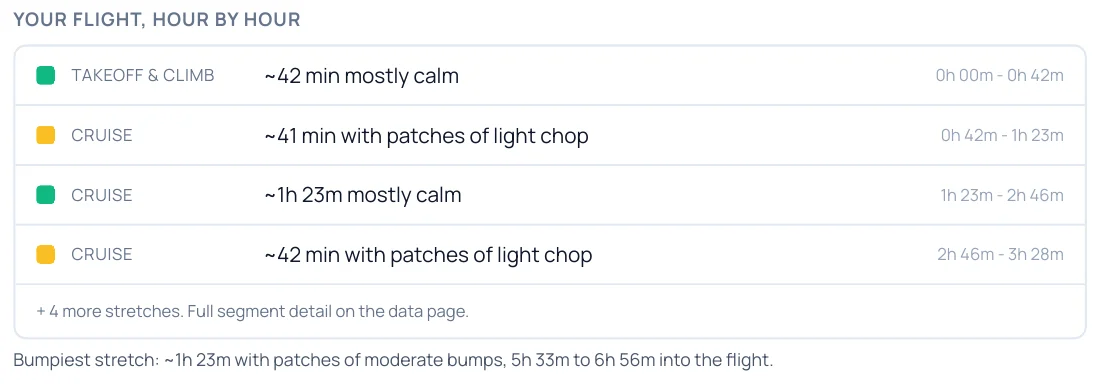
- Check the turbulence forecast for your route - sometimes the smoothest-ride seat matters more than usual.
FAQ
Do bulkhead seats feel more turbulence?
Only marginally. Bulkheads are usually at cabin-zone dividers and don't correlate with position relative to the center of gravity. If a bulkhead is at the wing root (like row 21 on some A350 configurations), it's an excellent ride; if it's at the tail boundary, it's not.
Are emergency exit rows bumpier?
No - they're usually right over the wing or just behind it on most narrowbodies, so they're often among the smoothest seats on the aircraft. You may not be able to recline, and you'll get the safety briefing, but the ride is good.
Will a larger plane really feel less turbulence?
Yes. Mass matters. A 777 flying through a gust field that visibly shakes a regional jet will register as "light chop" to 777 passengers. This is the biggest single factor after seat position.
What if my airline doesn't publish a seatmap?
Every commercial aircraft follows the same physics. Look up the type (e.g. "A320" or "737-800"), pull up a generic seatmap, and count rows. The wing is always in the middle third of the fuselage.
Does seat choice help with severe turbulence?
Position helps with the subjective experience, but the single most important factor in severe turbulence is whether your seatbelt is fastened. That's more important than which seat you're in.
The short version
Pick a seat between the leading and trailing edge of the wing, keep your seatbelt fastened, and check the forecast for your route before you fly. That trio solves almost the entire passenger-side turbulence problem.
For frequent flyers, a general rule: book the same zone every time. It trains your body to expect a particular range of motion - most people find turbulence less unpleasant once they've "calibrated" to a specific seat position across multiple flights.
Flying soon?
Check the turbulence forecast for your exact route - free, no signup.
Related Articles
Is Turbulence Dangerous? What Every Passenger Should Know
Worried about turbulence? Learn why airplane turbulence is almost never dangerous, how aircraft are designed to handle it, and statistics that will ease your fears.
15 Tips for Nervous Flyers: How to Handle Turbulence
Practical ways to handle turbulence when flying makes you nervous: where to sit, how to breathe through the bumps, why to check the forecast once and then stop, and the facts worth holding on to.
Will Turbulence Crash a Plane? What the Aviation Safety Data Actually Shows
Short answer: almost certainly not. Here's the full engineering, historical, and statistical picture of how modern aircraft handle turbulence - including what the Singapore Airlines SQ321 incident really tells us.